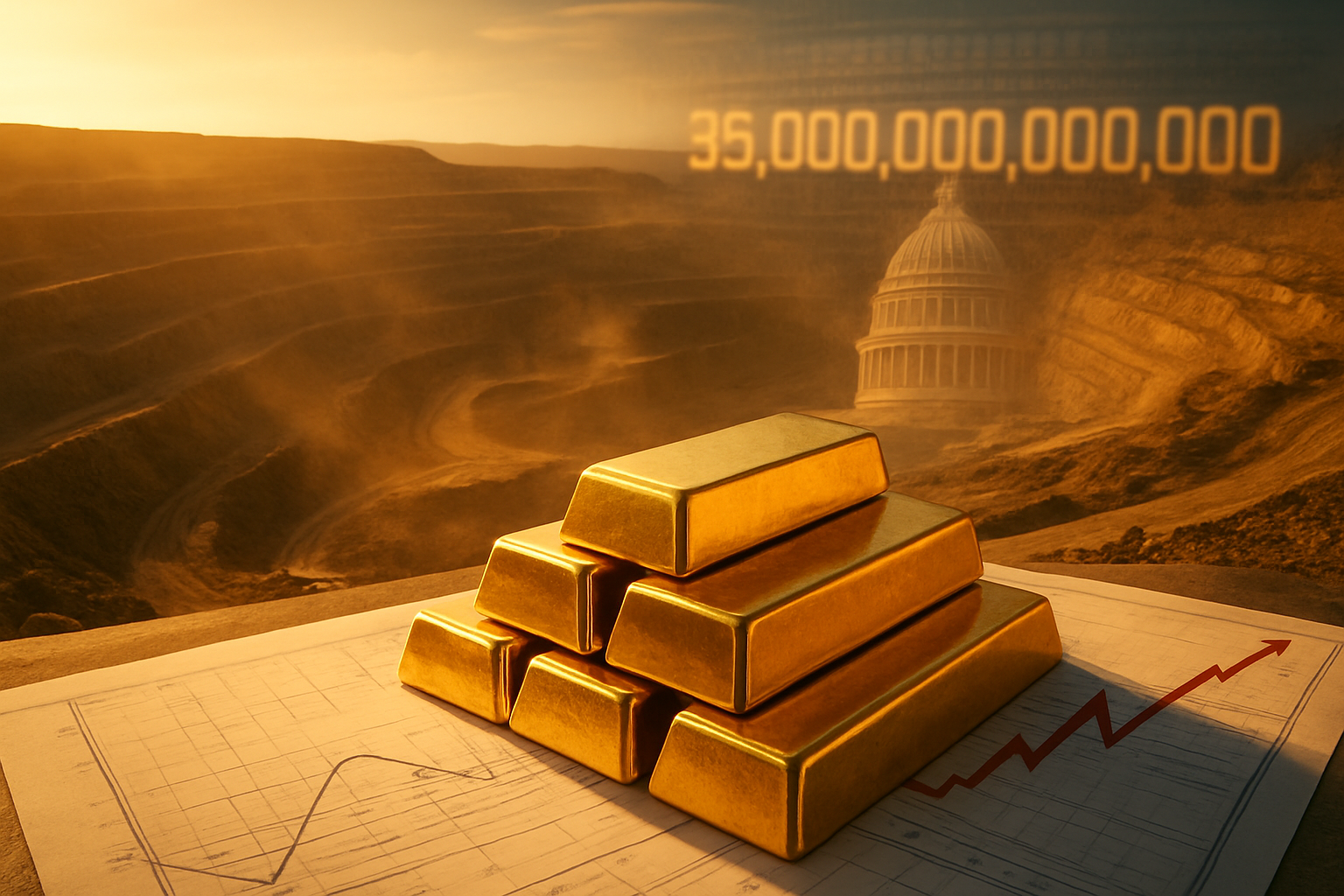
As of January 27, 2026, the global financial landscape has been reshaped by a historic bull run in precious metals. While the spot price of gold has shattered records to trade above $5,100 per ounce, it is the equities—the companies that pull the metal from the earth—that have become the primary focus of institutional and retail investors alike. The performance of the sector’s primary investment vehicles has been nothing short of extraordinary, with the VanEck Gold Miners ETF (NYSE: GDX) delivering a staggering 189% return over the past 12 months, dwarfing the returns of broader equity indices.
This "Golden Age" of mining is not merely a reflection of higher bullion prices, but a fundamental re-rating of the sector’s profitability. Investors are increasingly moving away from the "safety" of physical gold held via the SPDR Gold Shares (NYSE: GLD) in favor of the amplified returns found in mining stocks. This shift is particularly evident in the junior mining space, where the VanEck Junior Gold Miners ETF (NYSE: GDXJ) has emerged as the market’s standout performer, outperforming its large-cap counterpart by 13% over the course of 2025.
The Engines of Amplification: Leverage and Margin Expansion
The spectacular rally witnessed throughout 2025 and into January 2026 is rooted in the concept of operating leverage. For much of the previous decade, gold miners struggled with stagnant prices and rising All-In Sustaining Costs (AISC). However, as gold climbed from $2,500 toward $5,000, the "mathematics of the margin" shifted violently in favor of the producers. While costs for major producers like Newmont (NYSE: NEM) and Barrick Gold (NYSE: GOLD) remained relatively stable between $1,400 and $1,600 per ounce, the tripling of the spot price allowed profit margins to expand by nearly 500%.
The outperformance of the VanEck Junior Gold Miners ETF (NYSE: GDXJ) compared to the GDX in 2025 can be attributed to the "marginal asset" phenomenon. In a $2,000 gold environment, many junior and mid-tier miners operated on thin or non-existent margins. As the price surged, these high-cost projects were transformed from marginal operations into cash-flow machines. Furthermore, a 17% decline in crude oil prices during late 2025 provided a significant tailwind for the juniors, as energy typically represents a higher percentage of operating costs for smaller, less efficient mines than for diversified majors like Agnico Eagle Mines (NYSE: AEM).
The timeline of this ascent was punctuated by a series of breakout moments. In early 2025, a wave of central bank accumulation set the floor at $3,000. By mid-year, the passage of the "One Big Beautiful Bill Act" in the United States—which expanded fiscal deficits—triggered a speculative frenzy. This culminated in a January 2026 "blow-off top" for mining equities, as the market began to price in gold as a permanent, high-value fixture of the global monetary system rather than a cyclical commodity.
Winners and Losers in the New Golden Order
The primary beneficiaries of this cycle have been the agile mid-tier producers and exploration-heavy juniors. Companies such as Equinox Gold (NYSE: EQX) and Eldorado Gold (NYSE: EGO) have seen their market caps swell as they successfully ramped up production to capture the $5,000+ price environment. Eldorado Gold, in particular, gained significant traction in late 2025 following high-grade discoveries at its Olympias and Stratoni projects, proving that exploration success remains the ultimate "alpha" generator in a bull market.
Conversely, the "losers" in this environment have been traditional fixed-income portfolios and diversified industrial conglomerates that failed to hedge against rising input costs. While the miners are winning, the broader market has struggled with the fiscal weight of a $38.5 trillion U.S. national debt. Investors who remained solely in physical gold through the SPDR Gold Shares (NYSE: GLD) have seen substantial gains, but they have missed out on the "double-alpha" provided by the mining sector’s operational and financial leverage.
Merger and acquisition (M&A) activity has also defined the winners' circle. Throughout 2025, major miners began a frantic bidding war to replenish depleted reserves, paying 40% to 50% premiums for mid-tier targets. This consolidation trend has benefitted GDXJ shareholders, as many of the ETF's holdings became acquisition targets. The trend is expected to continue through 2026, as the "majors" use their massive free cash flow to buy growth rather than risk greenfield exploration.
The Macro Catalyst: Debt, Sovereignty, and the 'Neutral' Reserve
The underlying driver for this historic performance is a profound shift in the global perception of the U.S. dollar and the role of sovereign reserves. With the U.S. national debt accelerating at a rate of $8 billion per day and interest servicing costs exceeding $1 trillion annually, the narrative has shifted away from gold as a mere "inflation hedge." Instead, gold is now viewed as a "politically neutral" reserve asset—a "Golden Shield" that offers immunity from Western sanctions and fiscal instability.
This narrative gained momentum in late 2025 as central banks from the Global South and BRICS+ nations accelerated their diversification efforts. Unlike U.S. Treasuries, which are now perceived as carrying significant "political and fiscal risk," gold represents a store of value that is not someone else's liability. This has led to a "Sell America" trade among some global reserve managers, who are replacing aging dollar-denominated bonds with bullion and mining interests.
Historically, periods of extreme fiscal stress in the world's reserve currency issuer have always led to a re-rating of hard assets. However, the 2025-2026 rally is unique in its scale. The 189% return for GDX reflects a market that is no longer just betting on a higher gold price, but on a structural change in how the world defines "money." The regulatory environment has also shifted, with several jurisdictions in early 2026 considering legislation to allow gold-backed sovereign bonds, further cementing the metal’s role in the modern financial architecture.
Navigating the Future of the Mining Super-Cycle
As we move further into 2026, the question for investors is whether the miners can sustain these parabolic gains. In the short term, the primary risk remains "input cost inflation." While energy prices dipped in 2025, the cost of specialized labor and mining equipment is rising as every company in the sector attempts to expand production simultaneously. If the miners cannot contain these costs, the "super-margins" currently driving GDX and GDXJ could begin to compress, even if the gold price remains high.
Strategically, the next phase of the bull market will likely see a pivot toward "yield and return of capital." Having repaired their balance sheets and funded their growth pipelines, major producers like Agnico Eagle Mines (NYSE: AEM) are under increasing pressure to return their record profits to shareholders via dividends and buybacks. This transition from "growth at any cost" to "disciplined value" will be a key theme for the remainder of 2026.
Potential scenarios range from a continued "melt-up" if U.S. debt levels trigger a credit rating downgrade, to a healthy correction if the Federal Reserve manages to stabilize the fiscal outlook. However, with gold now entrenched above $5,000, the floor for mining equities has fundamentally moved higher. The market opportunities in 2026 will likely reside in the "orphaned" juniors that have yet to be acquired or fully priced in by the surging GDXJ.
The Lasting Impact of the $5,000 Gold Era
The performance of GDX, GDXJ, and GLD in January 2026 marks a turning point in modern financial history. The 189% surge in the mining sector is a clear signal that investors are seeking the amplified returns of "gold in the ground" to offset the risks of a ballooning global debt pile. The 13% outperformance of junior miners in 2025 highlights the market's appetite for risk and its recognition of the massive margin expansion possible in smaller producers.
Moving forward, the market will remain hyper-sensitive to U.S. fiscal policy and central bank accumulation trends. Investors should watch for signs of "M&A exhaustion" and monitor the AISC reports of major miners for hints of margin compression. While the volatility of the mining sector is legendary, the current environment—defined by a $38.5 trillion debt load and a yearning for politically neutral assets—suggests that the gold miners are no longer just a "trade," but a core component of the new institutional portfolio.
The "Golden Age" is here, and while the physical metal in GLD provides the foundation, it is the miners in GDX and GDXJ that are building the skyscrapers of wealth in this unprecedented economic era.
This content is intended for informational purposes only and is not financial advice.