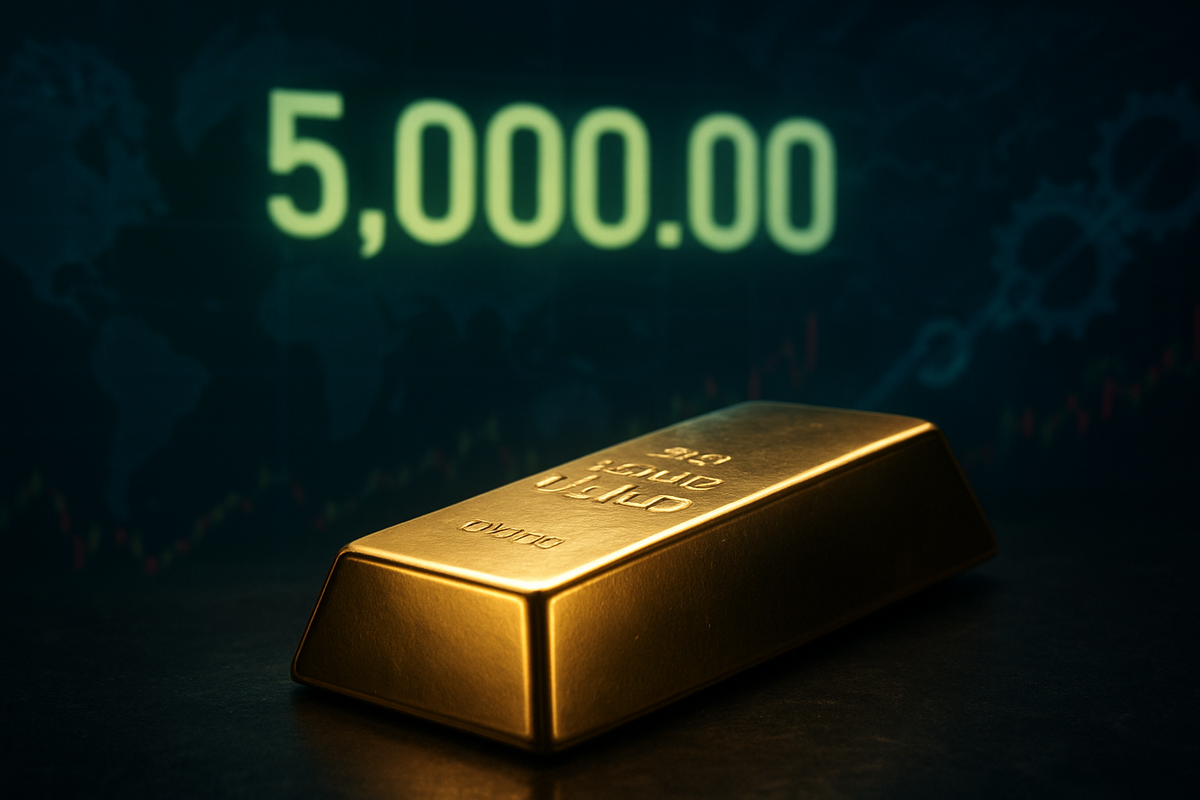
The global financial landscape reached a staggering milestone on January 26, 2026, as gold prices surged past the $5,000 per ounce mark for the first time in history. The precious metal, long considered the ultimate safe-haven asset, witnessed a dramatic daily rip of 1.41% to 1.95%, signaling a profound shift in investor sentiment and a collective flight from traditional fiat currencies. This historic rally is not merely a technical breakout but a visceral reaction to a mounting "perfect storm" of geopolitical fracturing and systemic economic anxiety.
The implications of $5,000 gold are far-reaching, fundamentally altering the valuation of global reserves and the cost structures of several major industries. As the psychological barrier of $5,000 falls, the market is grappling with the reality that the "inflation hedge" narrative has evolved into a "systemic insurance" play. With global debt levels reaching unsustainable heights and trade tensions escalating into a new era of protectionism, the surge reflects a world increasingly skeptical of traditional financial stability.
A Perfect Storm: The Path to $5,000
The events of January 26 were the culmination of several years of mounting pressure. Throughout 2025 and early 2026, the global economy faced a series of shocks, including the implementation of aggressive 100% tariffs by major world powers, which severely undermined the dominance of the U.S. dollar in international trade. As confidence in the "Greenback" wavered, central banks across the globe—most notably in Poland, China, and India—accelerated their gold accumulation at a pace not seen in decades. This structural shift in demand created a supply-demand imbalance that finally boiled over this week.
The final catalyst for the breach of $5,000 was a fresh wave of geopolitical instability in the Middle East and renewed friction along North American trade borders. On January 26, as news of stalled diplomatic negotiations broke, institutional investors flooded the gold markets. The trading day saw intense volatility, with spot prices climbing steadily from $4,910 in early Asian trading to a peak of over $5,035 during the New York session. Market participants reported a "buying frenzy" that overwhelmed short-sellers, leading to the rapid 1.95% intraday gain.
Initial reactions from the financial community have been a mix of awe and caution. Analysts at major institutions like Goldman Sachs and J.P. Morgan noted that while the $5,000 level was long forecasted by "gold bugs," the speed of the final ascent has caught many by surprise. The surge has triggered a massive rebalancing in global portfolios, with the SPDR Gold Shares (NYSE: GLD) and the iShares Gold Trust (NYSE: IAU) seeing record-breaking inflows as retail and institutional investors alike scrambled for physical exposure.
Winners and Losers in the New Gold Era
The vertical move in gold prices has created a stark divide in the corporate world. The primary beneficiaries are the major gold producers, whose profit margins have expanded exponentially. Newmont Corporation (NYSE: NEM), the world’s largest producer, is currently operating with All-In Sustaining Costs (AISC) near $1,600 per ounce. With gold at $5,000, Newmont’s profit margin on every ounce mined exceeds $3,400, a level of profitability that was once considered a mathematical impossibility. Similarly, Barrick Gold Corporation (NYSE: GOLD) and Agnico Eagle Mines Limited (NYSE: AEM) have seen their stock prices skyrocket as investors seek "leveraged" exposure to the metal.
Junior and mid-tier miners like Kinross Gold Corporation (NYSE: KGC) and AngloGold Ashanti (NYSE: AU) have also seen massive rallies. Historically, mining equities tend to amplify the moves of the underlying metal by a factor of two or three; this trend held true on January 26, with the VanEck Gold Miners ETF (NYSE: GDX) outperforming the spot price move significantly. These companies are now sitting on record levels of free cash flow, leading to widespread expectations of massive dividend hikes and special share buyback programs in the coming quarters.
Conversely, the "downstream" industries are facing a severe crisis. Jewelry retailers are experiencing profound demand destruction. Signet Jewelers Limited (NYSE: SIG), the parent company of Kay Jewelers and Zales, is struggling to maintain its entry-level price points as the cost of raw gold becomes prohibitive for the middle-class consumer. In international markets, retail giants like Chow Tai Fook Jewelry Group (HKG: 1929) have reported a significant pivot among consumers from buying jewelry for adornment to purchasing small investment bars, which carry much lower margins for the retailers.
Industrial users are also under pressure. Tech giants and semiconductor manufacturers like Texas Instruments (NASDAQ: TXN) are facing rising costs for the gold bonding wires and coatings essential for high-end electronics. While these companies have historically attempted to "thrift" by using thinner gold layers or substituting copper, the sustained $5,000 price point is forcing a more aggressive—and expensive—redesign of many consumer electronics, which could eventually be passed on to the public in the form of higher prices for smartphones and electric vehicles.
Historical Significance and Global Trends
The rise to $5,000 gold marks a definitive chapter in the story of "de-dollarization." For the better part of a century, the U.S. dollar has been the undisputed reserve currency, but the weaponization of the dollar through sanctions and the ballooning G7 fiscal deficits have eroded that status. This event mirrors the gold spikes of the late 1970s and 2008, yet on a much larger scale. In the 1970s, gold rose as a hedge against runaway inflation and a broken currency system; in 2026, it appears to be serving as a hedge against a breaking geopolitical order.
This milestone also highlights the structural change in how the "safe haven" is defined. In previous decades, U.S. Treasuries were the go-to refuge during times of strife. However, with the current volatility in the bond market and concerns over debt sustainability, gold has reclaimed its status as the only "non-yielding competitor" to sovereign debt that carries no counterparty risk. This trend is likely to influence regulatory discussions regarding bank capital requirements, with some nations already considering increasing the weight of gold in their Tier 1 reserve assets.
The ripple effects are being felt in the broader commodities market as well. Silver and platinum have begun to track gold's move, though with their own unique industrial supply constraints. The precedent set by gold's move to $5,000 suggests that the "hard asset" cycle is far from over, potentially leading to a broader revaluation of all tangible assets relative to fiat currencies.
What Lies Ahead: The $6,000 Question
In the short term, market analysts expect a period of intense volatility. Breaking such a major psychological level often leads to a "blow-off top" followed by a sharp technical correction as traders take profits. However, the fundamental drivers—geopolitical tension and de-dollarization—remain unaddressed, suggesting that any pullbacks may be short-lived. Some aggressive forecasts now point to $6,000 as the next major target if central bank buying does not subside.
The coming months will require strategic pivots from both corporations and governments. Mining companies will likely accelerate exploration projects that were previously deemed too expensive, while tech companies will double down on material science to find alternatives to gold. For the public, the "Gold Standard" of living—at least in terms of luxury goods—may be permanently altered, as gold jewelry becomes an increasingly exclusive luxury.
Market opportunities will likely emerge in the "junior" exploration sector, as represented by the VanEck Junior Gold Miners ETF (NYSE: GDXJ), which tracks smaller companies that could be prime acquisition targets for the cash-rich majors. However, these opportunities come with significant risks, as inflationary pressures on fuel and labor continue to plague the mining industry's operational side.
Closing Perspective on a New Financial Reality
The breach of $5,000 gold on January 26, 2026, is a watershed moment for the global economy. It serves as a stark barometer of the current state of global instability and the diminishing confidence in the traditional financial systems that have governed the world since the end of World War II. For investors, the event underscores the importance of asset diversification and the enduring value of tangible assets in a period of systemic change.
As the market moves forward, the primary focus will be on whether this new price floor holds. If $5,000 becomes the "new normal," the world will have to adapt to a reality where the cost of security and the price of stability have never been higher. Investors should watch central bank reserve reports and monthly inflation data closely in the coming months to determine if this rally has the legs to reach even more historic heights.
This content is intended for informational purposes only and is not financial advice.