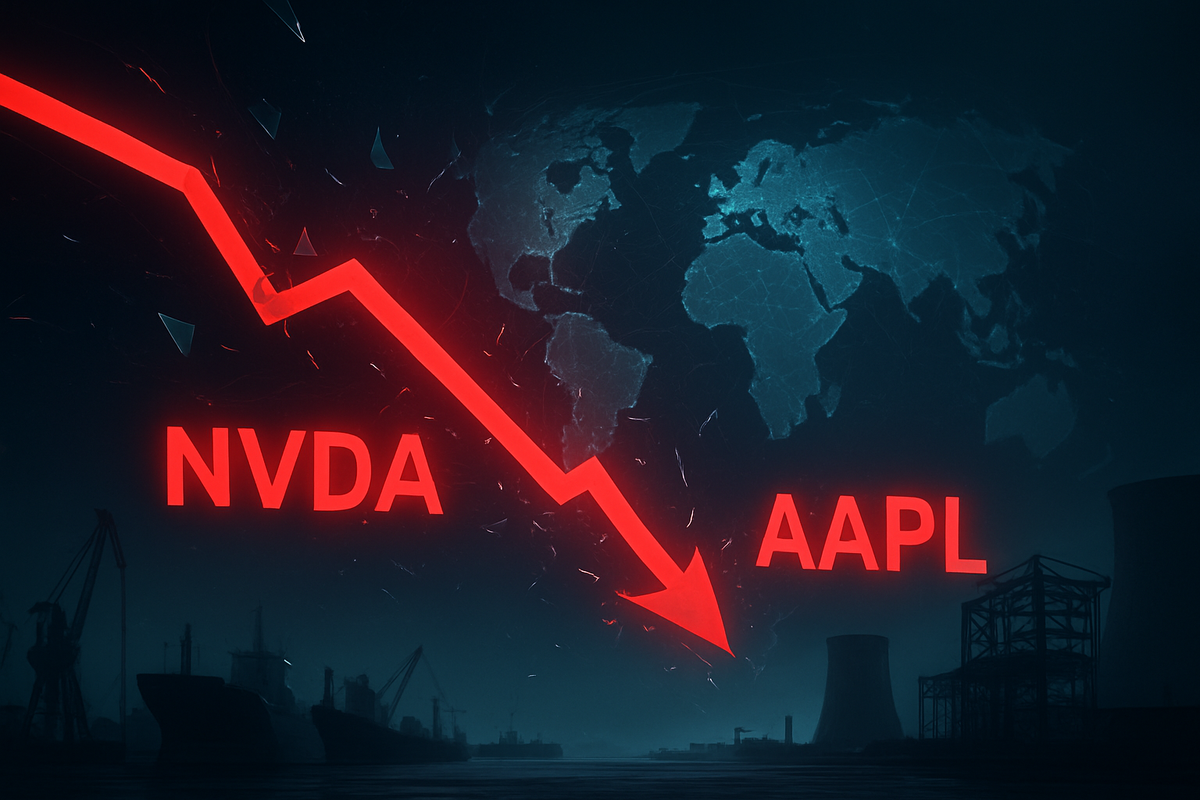
As of January 21, 2026, the era of unbridled growth for Silicon Valley’s elite is facing its most significant challenge yet. A perfect storm of "technical corrections" and aggressive geopolitical shifts has sent shockwaves through the technology sector, leaving investors scrambling to rebalance portfolios. In the third week of January, the market’s darlings—specifically NVIDIA Corporation (NASDAQ: NVDA) and Apple Inc. (NASDAQ: AAPL)—have officially entered correction territory, as the dream of a frictionless global AI rollout collides with the reality of fragmented trade policies and new "Greenland-style" diplomatic brinkmanship.
The shift, now being dubbed "The Great Realignment," represents more than just a momentary dip in stock prices. It is a fundamental repricing of risk as the global economy transitions from speculative AI software expansion into a period defined by physical infrastructure bottlenecks and nationalist trade agendas. With the CBOE Volatility Index (VIX) surging past 20 this week, the "low-fear" environment that characterized 2025 has evaporated, replaced by a cautious pivot toward defensive assets and the "Old Economy" staples of energy and materials.
The January Slide: A Timeline of the Correction
The volatility began in earnest over the weekend of January 17–18, 2026, when an unexpected diplomatic rift sent global markets into a tailspin. In a bid to secure renewed leverage for a purchase of Greenland, the U.S. administration threatened tariffs of 10% to 25% on eight European NATO allies, including Germany and France. This "Greenland Tariff Crisis" immediate cooled investor sentiment, as analysts feared a breakdown in the transatlantic trade relationships essential for the tech supply chain. By the morning of January 20, the Nasdaq Composite shed 2.4%, marking its steepest single-day drop since the previous autumn.
NVIDIA Corporation (NASDAQ: NVDA) felt the brunt of this geopolitical friction. Shares dropped 4.4% to roughly $178 per share on January 20, leaving the stock 13.7% below its October 2025 peak of $207.04. The sell-off was exacerbated by news from China, where the State Administration for Market Regulation (SAMR) escalated an antitrust probe into Nvidia's 2020 Mellanox merger. Concurrently, Beijing reportedly blocked imports of the high-end H200 chips, despite prior U.S. export clearances. This renewed "chip war" has signaled that even the most dominant hardware providers are not immune to sovereign intervention.
Apple Inc. (NASDAQ: AAPL) faced a similar fate, falling 4.3% to $244.50, a decline of over 14% from its December all-time high of $286.19. For Apple, the pressure is two-fold: softening consumer demand in a tariff-wary Europe and the logistical nightmare of navigating a global supply chain increasingly divided by trade blocs. While a mid-January deal with Taiwan Semiconductor Manufacturing Company (NYSE: TSM) capped tariffs on Taiwanese chips at 15% in exchange for a massive $250 billion commitment to U.S.-based manufacturing, the cost of these "onshoring" initiatives is beginning to weigh on margins, prompting institutional giants like Morgan Stanley (NYSE: MS) to trim their exposure.
Identifying the Winners and Losers of the Realignment
In this reshuffled landscape, the clear "losers" are the high-multiple growth stocks that rely on global seamlessness. Nvidia, which had reached a $5 trillion market cap in late 2025, is now seeing its valuation scrutinized. Investors are demanding proof of operational efficiency over speculative growth, particularly as the "Vera Rubin" AI platform faces potential delays due to the new trade barriers. Similarly, other semiconductor players and software-as-a-service (SaaS) providers are being punished as the cost of capital remains high and the promise of "sovereign AI" forces companies to build fragmented, localized data centers rather than efficient global ones.
Conversely, the "winners" of early 2026 are found in the tangible world of physical infrastructure and defensive materials. As institutional capital flees tech, it is rotating into the Basic Materials and Energy sectors. Companies involved in "Physical AI Infrastructure"—the nuclear energy, specialized cooling, and electrical grid systems required to power the AI revolution—are seeing record inflows. Investors are increasingly looking at "Old Economy" titans like BlackRock, Inc. (NYSE: BLK), which has led the charge into private infrastructure funds, as the more stable bet in a volatile world.
The shift also favors regions like India and Japan, which are emerging as "neutral zones" in the trade spats between the U.S., Europe, and China. Global portfolio managers are diversifying into these markets as a hedge against the unpredictability of the Greenland Crisis. This geographic diversification is creating a new tier of market winners: the regional logistics and manufacturing firms that are stepping in to fill the gaps left by the retreating "Magnificent Seven" tech giants.
A Historical Pivot: Beyond the Dot-Com Comparison
The current technical correction bears some resemblance to the 2000 dot-com bubble, yet the drivers in 2026 are fundamentally different. While the 2000 crash was largely about a lack of revenue, today’s tech giants like Nvidia and Apple are immensely profitable. The current crisis is one of "geopolitical friction," where the political environment has become the primary bottleneck for technological scaling. This event fits into a broader trend of "Deglobalization 2.0," where trade policy is used as a blunt instrument for territorial and diplomatic gains, rather than just economic protectionism.
The ripple effects are already being felt by competitors and partners. The Taiwan deal, while providing some certainty for TSM, has set a high price for entry into the U.S. market that smaller chipmakers may not be able to afford. This could lead to a wave of consolidation as the industry adjusts to a "pay-to-play" manufacturing environment. Furthermore, the regulatory implications are profound; the "Greenland Taxes" have prompted European regulators to reconsider their own digital services taxes, potentially creating a "tit-for-tat" tax war that could further erode the profitability of American tech exports.
Historically, market corrections driven by geopolitics tend to be sharper and more unpredictable than those driven by pure economic data. The 2026 volatility suggests that the "peace dividend" that allowed tech companies to treat the world as a single market is officially over. We are entering a period where the "Chief Trade Officer" may become as important as the Chief Technology Officer in determining a company's success.
The Road Ahead: Strategic Pivots and New Realities
In the short term, the market is likely to remain in a state of flux as the February 1st deadline for the Greenland tariffs approaches. Strategic pivots are already underway; we can expect to see Nvidia and Apple accelerate their "Sovereign AI" strategies, building localized supply chains that are less susceptible to sudden tariff shifts. This will likely involve a heavier reliance on automated, domestic manufacturing, which could stimulate the U.S. industrial sector even as it depresses tech margins in the near term.
Long-term, the challenge for these mega-cap companies will be maintaining their high P/E ratios in a world where "global scale" is no longer a given. A possible scenario is a "bifurcated market," where tech companies trade at lower multiples than in the early 2020s, reflecting the higher risks of international operations. However, this also creates opportunities for "Physical AI" firms that can bridge the gap between the digital and physical worlds—nuclear power providers and infrastructure REITs may become the new growth engines of the late 2020s.
Potential scenarios range from a diplomatic resolution to the Greenland dispute, which would trigger a massive relief rally in tech, to a full-blown trade war that could lead to a secular bear market for growth stocks. Investors will need to be nimble, moving away from "set-it-and-forget-it" index funds and toward active management that can navigate the nuances of international trade law and regional manufacturing shifts.
Closing Thoughts: A New Market Paradigm
The market volatility of early 2026 serves as a stark reminder that technology does not exist in a vacuum. The correction in NVIDIA Corporation and Apple Inc. is a symptom of a world where geopolitics has reasserted itself as the dominant force in the global economy. The key takeaway for investors is that the "AI Gold Rush" has entered its second phase—a phase where the picks and shovels are increasingly made of steel, concrete, and energy, and where the boundaries of the digital map are drawn by politicians, not just programmers.
As we move forward, the "Great Realignment" will likely define the remainder of the decade. Market participants should watch the February tariff implementation dates and the progress of the SAMR probe in China as the primary indicators of where the next leg of volatility may come from. While the technical corrections are painful for growth-heavy portfolios, they also represent a necessary clearing of the air, paving the way for a more resilient, if more fragmented, global tech landscape.
This content is intended for informational purposes only and is not financial advice.