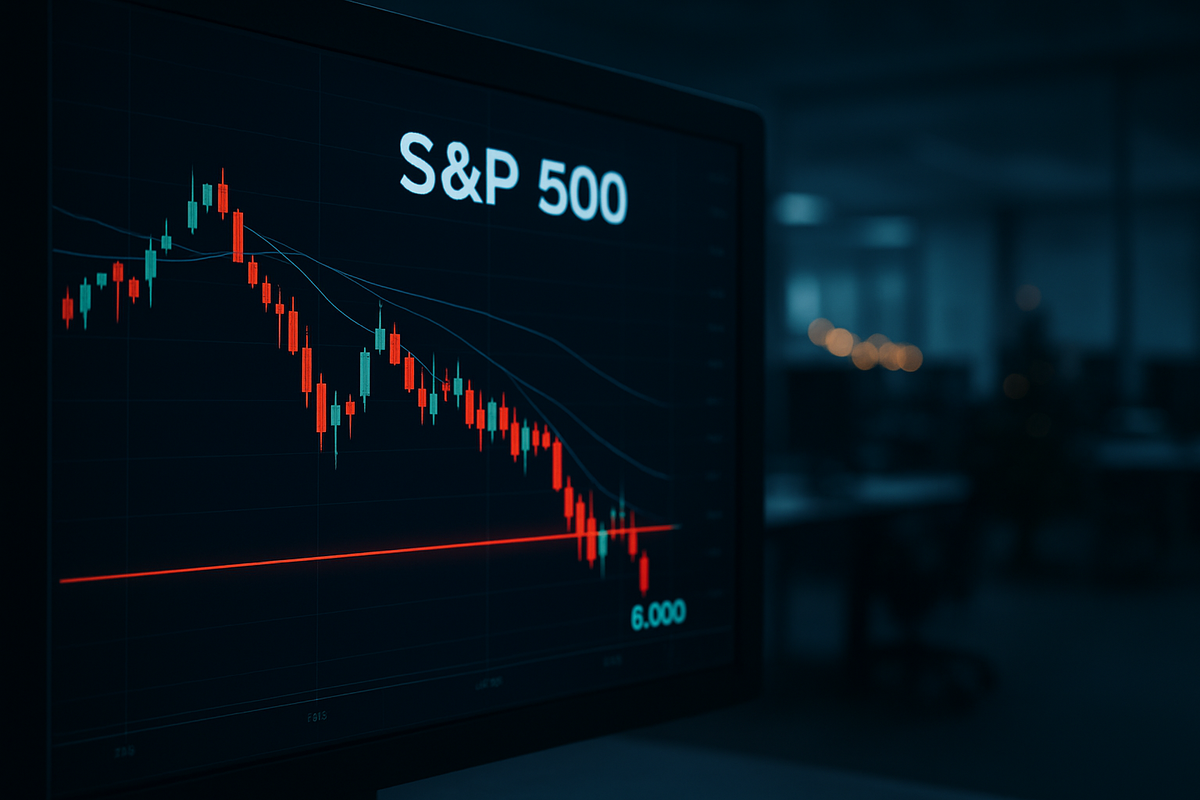
The S&P 500 (INDEXSP: .INX) is locked in a high-stakes technical tug-of-war this Tuesday, December 30, 2025, as it attempts to stave off its first three-day losing streak in over a month. After reaching a historic peak of 6,932.05 on Christmas Eve, the benchmark index has spent the final week of the year retreating from the precipice of the 7,000-point milestone. The current slide, characterized by profit-taking and institutional rebalancing, has seen the index lose nearly 1% over the last two sessions, leaving investors on edge as the 2025 trading calendar draws to a close.
The immediate implications of this struggle are felt most acutely through the lens of market liquidity. With many institutional desks shuttered for the holidays, trading volumes have plummeted to roughly one-third of their 30-day average. This "ghost town" environment has amplified intraday volatility, turning relatively small sell orders into significant price swings. For the American investor, the current consolidation represents a "tactical breather" after a year of relentless gains, but it also raises questions about whether the market has finally become "priced for perfection" heading into 2026.
A Clinical Battle for Technical Support
The retreat began in earnest on Friday, December 26, following the Christmas break, as fund managers moved to lock in gains from what has been a "triple-peat" year of double-digit returns. The S&P 500 had surged approximately 17.4% year-to-date by mid-December, marking the third consecutive year of massive growth following stellar performances in 2023 and 2024. However, the momentum hit a wall at the 6,940 resistance level, a ceiling that has proven impenetrable during this low-volume period.
By the opening bell on December 30, the index was testing a critical support zone between 6,820 and 6,848, which aligns with the running 20-day and 50-day moving averages. Technical analysts are watching this floor closely; a breach below 6,800 could trigger automated sell programs, potentially dragging the index toward its 100-day moving average at 6,650. The timeline of this week’s decline suggests a "de-risking" event, where investors are rotating out of high-flying artificial intelligence stocks and into defensive havens to protect annual bonuses and rebalance portfolios for the new year.
The Federal Reserve’s mid-December action has also added a layer of complexity to the week's trading. While the Fed issued a 25-basis point rate cut, bringing the range to 3.50%–3.75%, Chair Jerome Powell’s accompanying "hawkish" warnings regarding sticky 2.7% core inflation have tempered the traditional "Santa Claus Rally." This shift in tone has forced market participants to reconsider the aggressive easing path they had previously priced in for early 2026.
Winners and Losers in the Year-End Rotation
As the S&P 500 struggles to find its footing, the internal dynamics of the index reveal a significant "broadening" of the market rally. Nvidia Corp. (NASDAQ: NVDA), which briefly touched a staggering $5 trillion market cap earlier this month, has been a primary target for profit-taking. Trading near $189, the semiconductor giant is down from its recent highs as investors trim positions in the year's top performer. Similarly, Microsoft Corp. (NASDAQ: MSFT) has seen its shares hover around $490, lagging the broader index slightly as the market shifts its focus from "AI hype" to tangible "AI earnings validation."
Conversely, the "physical side" of the AI trade has produced surprise winners. Caterpillar Inc. (NYSE: CAT) has emerged as a standout, with its shares trading near $600—a 61% gain for the year. The massive demand for natural-gas generators to power new AI data centers has transformed the industrial stalwart into a high-growth play, outperforming most of the "Magnificent 7" in 2025. Financial giants are also holding their ground; JPMorgan Chase & Co. (NYSE: JPM) hit all-time highs of $329.17 just before the holiday, buoyed by a "deal-making renaissance" and improved capital market activity.
The "losers" in this environment are primarily found in sectors sensitive to the Fed's "higher-for-longer" inflation concerns. Real estate and high-dividend utilities, which had hoped for a more dovish Fed stance, have faced selling pressure this week. This divergence highlights a market that is no longer rising as a single tide; instead, capital is being surgically moved from overextended tech names into undervalued cyclical and industrial players.
Historical Precedents and the "Triple-Peat" Phenomenon
The current market environment is historically rare. If the S&P 500 maintains its double-digit gains through the final two days of 2025, it will mark only the second time in history that the index has delivered three consecutive years of 10%+ returns. This cumulative gain of approximately 77.5% since the end of 2022 has pushed the Shiller P/E ratio above 40, a level that has historically preceded periods of lower-than-average returns or significant corrections.
The "Santa Claus Rally"—typically defined as the final five trading days of December and the first two of January—usually averages a 1.3% gain. However, the 2025 version of this rally is being challenged by the sheer weight of the year’s previous gains. Market historians point to late 2021 as a comparison, where a late-December dip preceded a volatile start to the following year. The current "thin" trading volume acts as a double-edged sword: while it allows for quick recoveries, it also means that a lack of "buy-the-dip" conviction could lead to a deeper technical breakdown than fundamentals might suggest.
Furthermore, the broadening of the rally into the "S&P 493" (the index minus the top seven tech stocks) is a healthy sign for the long-term structure of the market. Throughout 2024 and early 2025, the rally was criticized for its narrowness. The recent surge in Caterpillar (CAT) and JPMorgan (JPM) suggests that the economic expansion is finally reaching the broader industrial and financial base of the American economy, potentially providing a more sustainable foundation for 2026.
The Road to 2026: Pivots and Scenarios
As the market enters the final 48 hours of 2025, the short-term focus remains squarely on the 6,900 level. If the S&P 500 can close above this mark, it will likely set the stage for a renewed assault on the 7,000 psychological milestone in early January. However, a failure to hold support could lead to a "January Effect" in reverse, where tax-loss harvesting and continued rebalancing create a rocky start to the first quarter.
Strategic pivots are already underway. Wealth managers are increasingly advising a shift toward "quality value"—companies with strong balance sheets and consistent cash flows that have not yet reached the stratospheric valuations of the tech sector. The potential for a "soft landing" remains the consensus view, but the emergence of "sticky inflation" could force the Fed to pause its rate-cutting cycle earlier than expected. This would create a challenging environment for growth stocks while potentially benefiting value-oriented sectors like energy and materials.
In the long term, the primary challenge for the market will be earnings growth. With the S&P 500 projected to grow earnings by 9% in 2025, the bar for 2026 is set high. Investors will need to see that AI investments are translating into bottom-line profits not just for the chipmakers, but for the enterprises adopting the technology.
Investor Takeaway: Watching the Volume and the VIX
The final days of 2025 are a reminder that even the strongest bull markets require periods of digestion. The S&P 500's struggle to avoid a three-day losing streak is less about a change in the fundamental economic outlook and more about the mechanics of a low-liquidity holiday market. The "triple-peat" of 2023-2025 has been a historic windfall for investors, but it has also left the market in a state of extreme valuation sensitivity.
Moving forward, investors should keep a close eye on trading volumes as they return to normal levels in the first week of January. A "volume-backed" bounce off the 50-day moving average would be a bullish signal for the first half of 2026. Conversely, if volatility—measured by the CBOE Volatility Index (INDEXCBOE: VIX)—begins to creep up from its current subdued levels, it may indicate that the "priced for perfection" narrative is starting to crack.
In summary, while the 7,000-point milestone remains tantalizingly close, the current technical struggle suggests that the market may need more time to consolidate its massive three-year run. For the patient investor, this week's volatility is likely noise; for the tactical trader, the 6,820 support level is the most important number on the screen as the curtain falls on 2025.
This content is intended for informational purposes only and is not financial advice