As the final weeks of 2025 unfold, Wall Street has found the "dovish oxygen" it desperately craved. Following a year of economic uncertainty and a historic 43-day government shutdown that blinded analysts for much of the fourth quarter, fresh data released this week has confirmed a significant cooling in consumer prices. This soft inflation data has not only fueled a massive "Santa Claus Rally" across major indices but has also solidified market bets that the Federal Reserve is firmly on a path toward further interest rate normalization, even as policymakers maintain a cautious stance for 2026.
The immediate implications are stark: the S&P 500 is currently pushing toward the 6,800 level, up approximately 17% year-to-date, while the tech-heavy Nasdaq has surged to new record highs. Investors are rapidly recalibrating their portfolios, moving away from defensive "wait-and-see" positions and pouring capital into high-growth technology, AI infrastructure, and beaten-down cyclical stocks. With the Federal Reserve having delivered its third consecutive rate cut on December 10, the market is now pricing in a "soft landing" scenario where inflation returns to target without a catastrophic spike in unemployment.
A December to Remember: The Data Behind the Rally
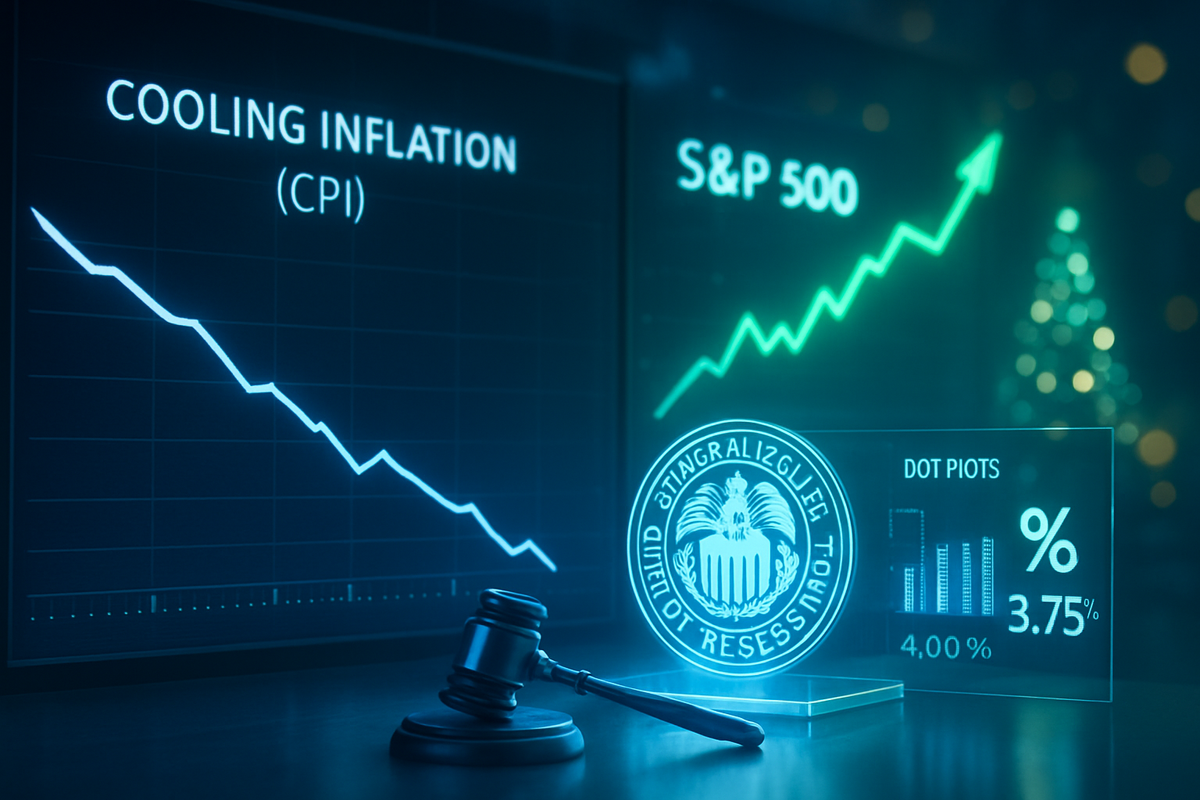
The catalyst for the current market euphoria arrived on December 18, 2025, with the release of the November Consumer Price Index (CPI). The headline inflation rate cooled to 2.7% year-over-year, significantly lower than the 3.1% economists had projected. Even more encouraging for the Federal Reserve was the Core CPI—which strips out volatile food and energy costs—falling to 2.6%, its lowest level since the post-pandemic surge of early 2021. This "undershoot" in the data provided the final piece of the puzzle for a market that had been trading on edge due to the data blackout caused by the autumn government shutdown.
This cooling trend followed the Federal Open Market Committee (FOMC) meeting on December 10, where Chairman Jerome Powell and the board voted to lower the federal funds rate by 25 basis points to a range of 3.50%–3.75%. While the cut was widely expected, the Fed's updated "dot plot" initially struck a hawkish tone, projecting only one additional cut for the entirety of 2026. However, the subsequent soft CPI print has led many market participants to believe the Fed may be forced to be more aggressive in the coming year if the labor market, which saw unemployment tick up to 4.6% in November, continues to soften.
The timeline leading to this moment was fraught with volatility. Throughout October and November, the lack of official government data led to wild swings in bond yields and equity prices. Private sector proxies had suggested inflation was sticky, but the official December reports revealed that the cooling trend was deeper than anticipated. The reaction was instantaneous: on December 18 alone, the Nasdaq jumped 1.38%, led by a massive surge in semiconductor and AI-related stocks that had previously been weighed down by high borrowing costs.
Winners and Losers in the Disinflationary Shift
The primary beneficiaries of this "soft landing" narrative have been the high-growth leaders of the 2025 market. Micron Technology, Inc. (NASDAQ: MU) emerged as a standout winner, with its shares soaring 10% following a blowout earnings report that coincided with the inflation data. The company’s leadership in high-bandwidth memory for AI applications, coupled with the prospect of lower capital expenditure costs, has made it a darling of the year-end rally. Similarly, Nvidia Corp. (NASDAQ: NVDA) and Oracle Corp. (NYSE: ORCL) saw significant relief rallies as the "cost of carry" for high-valuation growth stocks began to retreat.
Beyond the tech giants, the rally has breathed new life into speculative and cyclical names. Carvana Co. (NYSE: CVNA) has seen an extraordinary 80% rally in late 2025, driven by its inclusion in the S&P 500 and the easing of credit conditions that benefit its auto-financing model. In the energy sector, a surprising pivot came from Trump Media & Technology Group Corp. (NASDAQ: DJT), which surged 40% after announcing a $6 billion merger with nuclear fusion developer TAE Technologies. The deal highlights a growing trend of tech-adjacent firms moving into energy infrastructure to power the AI boom.
However, the rally has not been universal. Companies struggling with structural costs and trade-related headwinds have lagged behind. Nike, Inc. (NYSE: NKE) reported a 32% drop in net income, citing a $1.5 billion headwind from newly implemented tariffs and persistent product cost inflation. Similarly, Conagra Brands, Inc. (NYSE: CAG) saw its net sales decrease by nearly 7%, as the company continues to battle the "negative impact of cost of goods sold" (COGS) inflation. These "losers" of the current cycle illustrate that while headline inflation is falling, the "last mile" of price stabilization remains painful for traditional retail and consumer staple sectors.
The Wider Significance: A New Era of Monetary Policy
The current market environment marks a definitive shift from the "inflation-at-all-costs" era that defined 2022-2024. The Fed’s willingness to cut rates while inflation is still slightly above its 2% target suggests a return to a more balanced "dual mandate" focus, where the health of the labor market is given equal weight to price stability. This shift mirrors the "pre-emptive" cuts seen in the late 1990s, where the Fed successfully navigated a mid-cycle slowdown without triggering a recession.
Furthermore, the 2025 rally is inextricably linked to the broader industry trend of AI infrastructure. The merger between Trump Media and TAE Technologies underscores the market's realization that the next leg of economic growth will be constrained not by capital, but by energy. As interest rates fall, the massive capital investments required for nuclear fusion and next-generation data centers become more feasible, creating a feedback loop that supports higher equity valuations.
The ripple effects are also being felt in the commodities market. With the dollar weakening on the back of rate cut expectations, gold has hit record highs above $4,400 per ounce, benefiting miners like Pan American Silver Corp. (NYSE: PAAS). This suggests that while the market is betting on a soft landing, a segment of investors remains wary of long-term currency debasement and the potential for a "second wave" of inflation in 2026 driven by fiscal spending and tariffs.
What Comes Next: Navigating the 2026 Outlook
Looking ahead, the market faces a delicate balancing act. In the short term, the "Santa Claus Rally" is expected to carry the S&P 500 into the new year with significant momentum. However, the Federal Reserve’s "one-and-done" projection for 2026 remains a point of contention. If inflation continues to undershoot expectations, the Fed may be forced to pivot to a more dovish stance, potentially fueling an "overheating" scenario in the equity markets.
Strategic pivots will be required for companies like FedEx Corp. (NYSE: FDX) and Darden Restaurants, Inc. (NYSE: DRI), which have noted that while inflation is cooling, wage growth remains high. These firms must adapt to a consumer base that is increasingly "searching for value," as seen in the popularity of Olive Garden’s value-menu offerings. For investors, the challenge will be identifying which companies can maintain margins in a world where pricing power is diminishing but labor costs remain sticky.
The most significant wildcard for 2026 remains the geopolitical and regulatory landscape. The potential for further tariffs and the lingering effects of the 2025 government shutdown could create "noisy" data that complicates the Fed's decision-making process. Market participants should watch for the January 2026 jobs report as the next major inflection point for interest rate expectations.
Conclusion: The Market's Fragile Optimism
The late-2025 rally is a testament to the resilience of the U.S. economy and the market's ability to look past short-term disruptions. The combination of a 2.7% CPI print and a proactive Federal Reserve has provided the necessary "dovish oxygen" to propel indices to record heights. Key takeaways for the year-end include the dominance of AI as a growth engine and the increasing importance of energy infrastructure in the technology narrative.
Moving forward, the market’s trajectory will depend on whether the Fed can successfully navigate the "last mile" of its inflation target without triggering a deeper labor market contraction. While the current mood is celebratory, the "hawkish cut" of December serves as a reminder that the era of "easy money" is not returning in its previous form. Investors should remain vigilant, watching for signs of service-sector inflation persistence and the impact of fiscal policy on long-term yields. For now, however, the Santa Claus Rally is the gift that keeps on giving to a weary Wall Street.
This content is intended for informational purposes only and is not financial advice.
Featured Companies:
- Micron Technology, Inc. (NASDAQ: MU)
- Nvidia Corp. (NASDAQ: NVDA)
- Oracle Corp. (NYSE: ORCL)
- Carvana Co. (NYSE: CVNA)
- Trump Media & Technology Group Corp. (NASDAQ: DJT)
- Nike, Inc. (NYSE: NKE)
- Conagra Brands, Inc. (NYSE: CAG)
- FedEx Corp. (NYSE: FDX)
- Darden Restaurants, Inc. (NYSE: DRI)
- Pan American Silver Corp. (NYSE: PAAS)
- Carnival Corp. & plc (NYSE: CCL)
- Rocket Lab USA, Inc. (NASDAQ: RKLB)
Tags: #FederalReserve #Inflation #MarketRally #CPI #InterestRates #StockMarket #AI #EnergyTransition #SantaClausRally #FinancialNews #2025Outlook
Author: Expert Financial Journalist Date: December 19, 2025