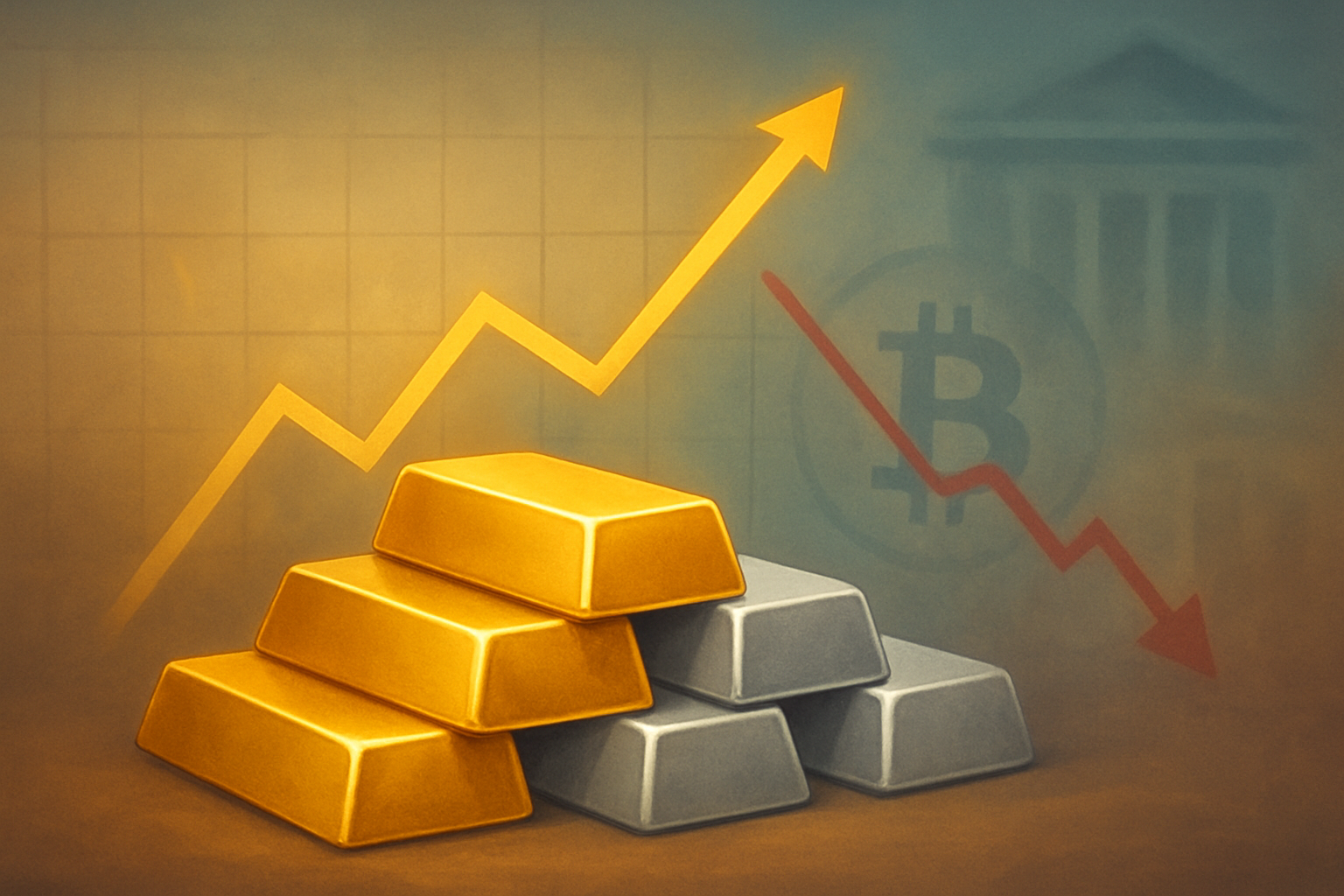
The financial landscape is undergoing a significant transformation as the global economy navigates the complex aftermath of extensive monetary policy interventions. In a notable shift, traditional safe havens, gold and silver, are demonstrating remarkable resilience and outperformance, leaving the once-dominant digital asset, Bitcoin, trailing in their wake. This pivot comes amidst a nuanced but undeniable move by central banks, particularly the Federal Reserve, towards more accommodative stances, signaling a potential return to conditions that historically favor precious metals over speculative assets.
As of December 2025, a clear "major market rotation" is underway. Investors, grappling with persistent monetary pressures and geopolitical uncertainties, are increasingly turning to the tangible security offered by gold and silver. This trend marks a critical re-evaluation of asset classes, challenging the narrative of Bitcoin as the ultimate inflation hedge and highlighting the enduring appeal of precious metals in an environment characterized by evolving central bank strategies.
The Federal Reserve's Pivot and Its Market Reverberations
The current market dynamics are intricately linked to a pivotal shift in the Federal Reserve's monetary policy. After systematically reducing its balance sheet through Quantitative Tightening (QT) since June 2022, the Fed officially concluded its QT program on December 1, 2025. This cessation was swiftly followed by further accommodative measures. On December 10, 2025, the Federal Open Market Committee (FOMC) implemented its third consecutive 25-basis-point (bps) rate cut, lowering the federal funds rate target range to 3.50%–3.75%. This represents a cumulative easing since mid-2024, designed to stabilize short-term funding markets and ensure ample bank reserves.
Adding to this dovish pivot, the Fed initiated "Reserve Management Purchases (RMPs)" of approximately $40 billion in Treasury bills starting December 12, 2025, over the subsequent 30 days. While characterized as a "technical liquidity tool" rather than a full-blown Quantitative Easing (QE) program, these RMPs are widely interpreted by market analysts as a precursor to, or a soft form of, balance sheet expansion. Such actions, which increase money supply and tend to weaken the purchasing power of fiat currencies, create an environment traditionally conducive to the appreciation of gold and silver as hedges against currency debasement and inflation.
The market's initial reaction has been unequivocal. Silver (XAGUSD) has been the standout performer, surging to an all-time high of $64.57 per troy ounce in December 2025. Its price of $64.51 on December 12, 2025, represented a staggering 111.75% increase compared to December 2024. This remarkable rally is fueled by a confluence of monetary factors, structural tightness in supply, and robust industrial demand from high-growth sectors such as solar energy, electric vehicles (EVs), and artificial intelligence (AI). Gold (XAUUSD) has also demonstrated significant strength, trading at $4329.41 per troy ounce on December 12, 2025, a 63.54% gain year-on-year, having hit a new all-time high of $4381.58 in October 2025. This consistent upward trajectory is bolstered by investor demand for safe havens amidst volatility, heightened geopolitical risks, and sustained strong demand from central banks, which are projected to have purchased around 900 tonnes in 2025.
In stark contrast, Bitcoin (BTC-USD) has experienced considerable volatility and a "classic decoupling" from the surging precious metals. After reaching an all-time high of over $126,198.07 on October 6, 2025, it quickly corrected, struggling to maintain support at the $90,000 level by December 11, 2025. Its maximum drawdown reached 36.22% from its peak, and November 2025 concluded with a decline of over 17% and net outflows from US spot ETFs. While Bitcoin benefited from inflation hedging narratives earlier in the year, its performance in late 2025 highlights its sensitivity to market liquidity and its more speculative nature compared to the steady ascent of gold and silver in the current accommodative monetary climate. As of October 16, 2025, silver had surged 83% year-to-date, and gold had risen over 60%, significantly surpassing Bitcoin's approximately 10% advance over the same period, underscoring the shift in investor preference.
Companies Navigating the Commodity Resurgence and Crypto Correction
The resurgence of precious metals and the concurrent struggles of Bitcoin create a distinct set of winners and losers among public companies. Mining companies focused on gold and silver are poised for significant gains, while some entities heavily invested in or reliant on Bitcoin's performance may face headwinds.
Gold mining giants like Barrick Gold Corp. (NYSE: GOLD) and Newmont Corporation (NYSE: NEM) are direct beneficiaries of rising gold prices. Higher commodity prices directly translate to increased revenue and potentially expanded profit margins, assuming production costs remain stable. These companies could see their stock prices appreciate as investors seek exposure to the booming precious metals market. Similarly, companies with significant silver operations, such as Pan American Silver Corp. (NASDAQ: PAAS) and Wheaton Precious Metals Corp. (NYSE: WPM), are experiencing a windfall from silver's exceptional performance. The dual tailwinds of monetary factors and robust industrial demand for silver, particularly from the solar, EV, and AI sectors, further amplify their prospects. Companies supplying these industrial sectors with silver, or those involved in the manufacturing of solar panels or EV components, could also see indirect benefits from increased demand for the metal.
Conversely, companies with substantial exposure to Bitcoin or the broader cryptocurrency market might face challenges. Cryptocurrency exchanges like Coinbase Global, Inc. (NASDAQ: COIN) could see reduced trading volumes and revenue during periods of Bitcoin price correction and investor exodus. Companies that have made significant corporate treasury allocations to Bitcoin, such as MicroStrategy Incorporated (NASDAQ: MSTR), will see the value of those holdings fluctuate with Bitcoin's price. While MicroStrategy has often framed its Bitcoin strategy as a long-term play, short-term volatility and underperformance relative to other asset classes could impact investor sentiment. Furthermore, investment funds and ETFs heavily weighted towards Bitcoin or other cryptocurrencies may experience outflows as investors rotate into more traditional safe havens. The "pure liquidity beta" characteristic of Bitcoin, where its price moves sharply with the expansion and contraction of liquidity, means that if the Fed's "technical" QE doesn't translate into broader market liquidity for speculative assets, Bitcoin-centric companies could continue to underperform.
Broader Implications: A Return to Fundamentals and Shifting Paradigms
This divergence in performance between precious metals and Bitcoin carries wider significance, hinting at a potential recalibration of investment strategies and a re-emphasis on traditional economic fundamentals. The narrative of Bitcoin as "digital gold" and a superior inflation hedge is being challenged, at least in the short to medium term, by the demonstrable strength of physical gold and silver in an accommodative monetary environment. This event fits into a broader industry trend of investors seeking tangible assets and proven safe havens when fiat currencies are perceived to be under pressure from central bank interventions.
The potential ripple effects are substantial. If precious metals continue their ascent, it could draw capital away from other asset classes, including certain segments of the equity market, particularly growth stocks that thrive on abundant liquidity. Competitors in the "inflation hedge" space, such as real estate or certain commodities, might also see renewed interest, though gold and silver currently appear to be leading the charge. Partners in the financial ecosystem, such as brokerages and wealth management firms, will need to adapt their client recommendations to reflect this shift in market preference. The strong central bank demand for gold, projected at around 900 tonnes for 2025, further underscores a global trend among monetary authorities to diversify reserves and reduce reliance on any single fiat currency, adding a powerful institutional tailwind to gold's performance.
Regulatory and policy implications are also noteworthy. The Federal Reserve's delicate dance between ending QT, cutting rates, and initiating RMPs highlights the ongoing challenge of managing liquidity without explicitly labeling it as full-blown QE. Should these "technical liquidity tools" continue or expand, it could cement the market's expectation for further currency debasement, reinforcing the appeal of gold and silver. Historically, periods of significant quantitative easing have consistently benefited precious metals, as investors seek protection against the erosion of purchasing power. The current environment, while not identical to past QE cycles, shares enough characteristics to trigger a similar investor response. This event serves as a powerful reminder that while technological innovation in finance (like cryptocurrencies) offers new investment avenues, the fundamental principles of supply, demand, and monetary policy still exert profound influence over traditional asset classes.
What Comes Next: Navigating a Shifting Investment Landscape
Looking ahead, the short-term and long-term possibilities suggest a continued favorable environment for precious metals, while Bitcoin's path forward remains more complex and dependent on broader liquidity conditions. In the short term, the Federal Reserve's ongoing "Reserve Management Purchases" and the general dovish tone signal that the accommodative monetary policy is likely to persist. This environment, characterized by increased money supply and lower interest rates, historically underpins the value of gold and silver. Investors should anticipate continued strong demand for these assets, driven by both institutional and retail interest seeking hedges against inflation and geopolitical instability.
For precious metals, potential strategic adaptations for companies could include increasing exploration budgets, expanding mining operations, and optimizing production to capitalize on higher prices. Market opportunities will emerge for investors to gain exposure through physical holdings, mining stocks, and precious metals ETFs. Challenges might include potential regulatory scrutiny on mining practices or unforeseen supply disruptions. For Bitcoin, the short-term outlook depends heavily on a broader return of market liquidity and a renewed risk-on sentiment. If the "technical" QE eventually translates into widespread market liquidity, Bitcoin could regain its footing. However, its "pure liquidity beta" suggests it will remain sensitive to any tightening of financial conditions.
In the long term, the debate between "digital gold" and physical gold will likely continue, but the current market performance provides a strong argument for the enduring value of traditional assets. Should central banks continue to grapple with managing national debts and stimulating economic growth through monetary expansion, the fundamental case for gold and silver as stores of value will only strengthen. Potential scenarios include a sustained bull market for precious metals, possibly leading to new all-time highs, while Bitcoin may carve out a niche as a high-beta speculative asset rather than a primary safe haven. Adaptations required for investors include diversifying portfolios, potentially rebalancing away from overly speculative assets, and considering a stronger allocation to precious metals.
A Comprehensive Wrap-Up: The Enduring Allure of Tangible Wealth
The current financial climate, marked by the Federal Reserve's pivot towards more accommodative monetary policies, has unequivocally positioned gold and silver as the leading performers, significantly outpacing Bitcoin. Key takeaways from this event include the powerful impact of central bank actions on asset performance, the enduring role of precious metals as safe havens against currency debasement and inflation, and the "classic decoupling" of Bitcoin from these traditional assets due to reduced market liquidity and its more speculative nature.
Moving forward, the market appears to be in a phase of "major market rotation," where investors are shifting capital from speculative growth assets to more tangible and historically reliable stores of value. The sustained demand from central banks for gold, coupled with the robust industrial demand for silver, provides strong fundamental support for their continued strength. Investors should assess their portfolios with this new reality in mind, considering the implications of ongoing monetary easing and geopolitical uncertainties.
What investors should watch for in the coming months includes any further announcements from the Federal Reserve regarding its balance sheet and interest rate policy, global inflation data, and the trajectory of industrial demand for silver. Additionally, monitoring geopolitical developments will remain crucial, as such events often drive demand for safe-haven assets. While Bitcoin's long-term potential remains a subject of debate, the current environment serves as a potent reminder of the timeless appeal and proven resilience of gold and silver in safeguarding wealth against the uncertainties of monetary policy.
This content is intended for informational purposes only and is not financial advice