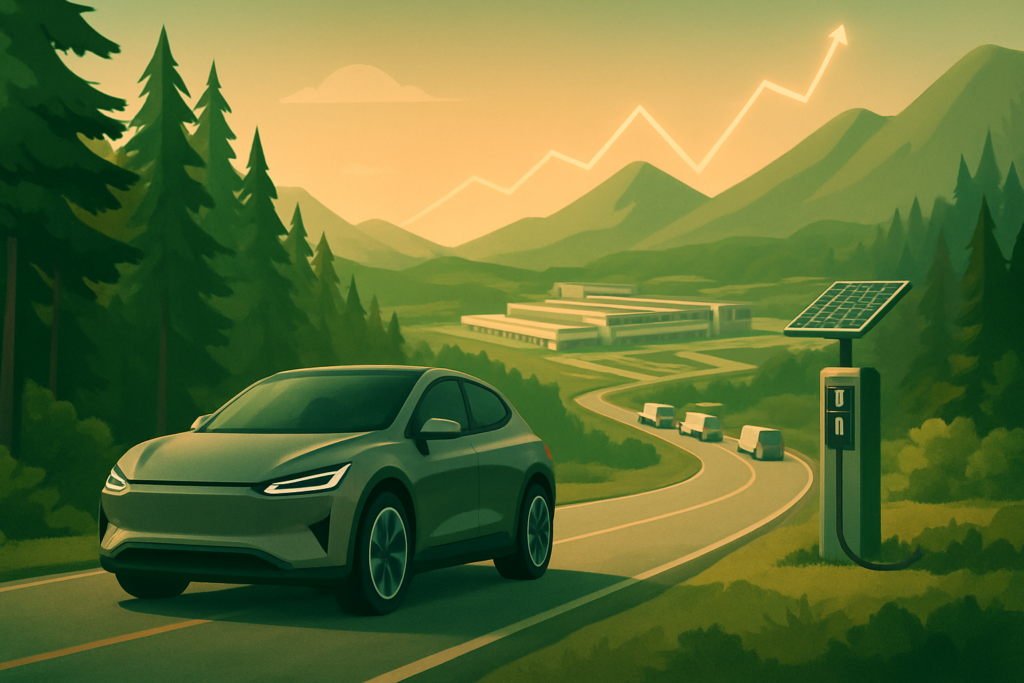
As of January 14, 2026, Rivian Automotive, Inc. (NASDAQ: RIVN) stands at the most critical juncture in its young history. Once the darling of the 2021 IPO boom, the Irvine-based electric vehicle (EV) manufacturer has spent the last year transforming from a boutique producer of high-end adventure trucks into a leaner, software-driven enterprise eyeing the mass market. With its upcoming "R2" mid-size SUV slated for launch in the first half of 2026, Rivian is attempting to bridge the gap between "niche enthusiast brand" and "global automotive powerhouse." However, this transition is occurring against a backdrop of significant macroeconomic shifts and a radically altered regulatory environment in the United States.
Historical Background
Founded in 2009 by Dr. RJ Scaringe, Rivian spent over a decade in "stealth mode," focusing on the engineering of its flexible "skateboard" platform. The company’s trajectory shifted permanently in 2019 when it secured a massive $700 million investment round led by Amazon, followed by a landmark order for 100,000 electric delivery vans (EDVs).
Rivian’s initial public offering in November 2021 was a historic event, briefly making it one of the world’s most valuable automakers by market cap before it had even achieved significant production. Since then, the company has navigated a grueling "production hell" period, a global supply chain crisis, and the complex task of scaling manufacturing at its plant in Normal, Illinois. By 2024 and 2025, Rivian pivoted toward cost-efficiency, redesigning its R1 flagship vehicles to reduce complexity and paving the way for the more affordable R2 platform.
Business Model
Rivian operates an integrated business model encompassing vehicle design, manufacturing, direct-to-consumer sales, and comprehensive after-sales services. Its revenue streams are currently categorized into three primary segments:
- Consumer Vehicles: The R1T (pickup) and R1S (SUV) serve the luxury "adventure" market. The forthcoming R2 and R3 platforms are designed to capture the $35,000–$50,000 price segment.
- Commercial Vehicles: The Electric Delivery Van (EDV) and the "Rivian Commercial Van" (RCV) platform, which is now available to non-Amazon customers.
- Software and Services: This is the fastest-growing segment, including Rivian’s proprietary autonomy software, infotainment subscriptions, and telematics for fleet management. In late 2025, this segment surged to represent nearly 27% of total revenue.
Stock Performance Overview
Rivian’s stock performance has been a rollercoaster for long-term holders. After peaking near $179 shortly after its 2021 IPO, the stock spent much of 2023 and 2024 in a downward drift as losses mounted.
In late 2025, the stock experienced a significant rally, climbing over 40% on the back of a successful "Autonomy Day" and optimism surrounding the Volkswagen joint venture. However, as of mid-January 2026, RIVN is trading between $18.00 and $19.50. While this is an improvement from its 2024 lows, the stock remains down nearly 90% from its all-time high. The recent dip in early January 2026 is largely attributed to a major safety recall and the removal of federal EV tax credits.
Financial Performance
Rivian’s financial health is a tale of two narratives: improving unit economics vs. massive capital requirements.
- Q3 2025 Highlights: Rivian achieved a major milestone by reporting its first consolidated gross profit of $24 million, driven by a 78% year-over-year increase in revenue to $1.56 billion.
- 2025 Full Year: The company produced 42,284 vehicles and delivered 42,247. While deliveries fell year-over-year compared to 2024, the average selling price (ASP) rose due to a higher mix of premium trims and software additions.
- 2026 Outlook: Analysts project 2026 revenue of approximately $6.9 billion to $7.0 billion. However, free cash flow burn remains a concern; estimates suggest a burn exceeding $4 billion in 2026 as the company ramps up for the R2 launch and begins construction on its Georgia plant.
Leadership and Management
Founder and CEO RJ Scaringe remains the central figure and strategic visionary. In early 2026, his leadership has focused on "vertical integration" and software. Following the departure of the Chief Commercial Officer in 2024, Scaringe continues to serve as the Interim Chief Marketing Officer, underscoring his hands-on approach to the brand's identity.
Key recent appointments include Greg Revelle as Chief Customer Officer, tasked with leading the go-to-market strategy for the R2. The board also saw the departure of Rose Marcario in January 2026, reflecting a tightening of the leadership circle as the company prepares for its largest-ever manufacturing ramp.
Products, Services, and Innovations
Rivian’s competitive edge lies in its "software-defined vehicle" (SDV) architecture.
- The R1 Refresh: The second-generation R1 vehicles (released in mid-2025) featured a completely redesigned electrical architecture that removed miles of wiring and reduced the number of ECUs.
- R2 Platform: The R2 is the "make-or-break" product. Currently in the "production-intent" prototype phase, it promises a 300+ mile range at a $45,000 price point.
- RAP1 Processor: Unveiled in December 2025, Rivian’s in-house AI processor powers its "Autonomy Platform," which the company aims to monetize through monthly subscriptions.
- VW Joint Venture: The "RV Tech" JV with Volkswagen Group (OTC: VWAGY) allows Rivian to license its zonal architecture and software to one of the world’s largest automakers, providing a steady stream of licensing revenue.
Competitive Landscape
Rivian faces a "pincer movement" from two sides:
- The EV Leader: Tesla (NASDAQ: TSLA) continues to dominate the price war with its Model Y, which directly competes with the upcoming Rivian R2.
- Legacy Powerhouses: Ford (NYSE: F) and General Motors (NYSE: GM) have slowed their EV transitions but remain formidable with their electric truck offerings and established dealer networks.
- Luxury Rivals: Lucid Group (NASDAQ: LCID) competes in the high-end luxury space, though Rivian has successfully carved out a unique "outdoor adventure" niche that separates it from Lucid’s "executive luxury" branding.
Industry and Market Trends
The EV industry in 2026 is navigating a "chasm" between early adopters and the mass market. High interest rates in 2024-2025 dampened consumer demand for expensive vehicles, leading many manufacturers to pivot toward hybrids. Rivian’s refusal to build hybrids makes it a "pure play" EV bet, which carries higher risk in the current environment. Additionally, the shift toward "Software Defined Vehicles" is now the primary battleground, where Rivian holds a perceived lead over traditional legacy manufacturers.
Risks and Challenges
- Regulatory Headwinds: The most significant recent blow came from the elimination of the $7,500 federal EV consumer tax credit in late 2025. This effectively increases the price for consumers, making Rivian’s push into the $45,000 segment more difficult.
- Safety Recalls: A January 8, 2026 recall of nearly 20,000 vehicles due to a steering-related defect has dented consumer confidence and added unexpected costs.
- Capital Intensity: The construction of the Georgia plant is a multi-billion dollar bet. If the R2 launch faces delays, Rivian could face a liquidity crunch by 2027.
Opportunities and Catalysts
- The R2 Launch (H1 2026): This is the primary catalyst for 2026. A successful, high-quality launch could re-rate the stock as a volume manufacturer.
- Monetization of Autonomy: If Rivian can achieve high attachment rates for its $100+/month autonomous driving features, its margin profile will shift closer to a software company than a traditional hardware company.
- International Expansion: The VW partnership provides a potential bridge for Rivian to enter the European market using VW's logistical support.
Investor Sentiment and Analyst Coverage
Wall Street remains divided. The consensus rating as of mid-January 2026 is a "Hold," with a median 12-month price target of $16.15.
- Bulls point to the first-ever gross profit in Q3 2025 as proof that the business model is scalable.
- Bears focus on the "funding gap" and the loss of government subsidies, which they argue will prevent Rivian from reaching net profitability before its cash reserves dwindle.
Regulatory, Policy, and Geopolitical Factors
The U.S. political landscape has turned more challenging for EVs. Beyond the loss of consumer tax credits, the current administration has shifted focus away from strict emissions mandates. On the positive side, Rivian has been able to leverage Section 232 tariff offsets for some auto parts, helping to keep production costs down. However, the loss of over $100 million in expected revenue from the sale of regulatory credits—due to changes in federal enforcement—remains a notable drag on the balance sheet.
Conclusion
Rivian enters 2026 as a company that has proven it can build world-class vehicles, but has yet to prove it can build a world-class, self-sustaining business. The progress made in software revenue and the landmark Volkswagen partnership provide a safety net that did not exist two years ago. However, the removal of the $7,500 tax credit and the looming capital expenditures for the Georgia plant mean there is no room for error.
Investors should watch the R2 launch in early 2026 as the definitive indicator of Rivian's future. If the company can maintain its brand prestige while scaling to high-volume production, it may finally fulfill the promise that drove its IPO. For now, it remains a high-beta, high-conviction play in a cooling EV market.
This content is intended for informational purposes only and is not financial advice.